

Mentors or Friends?
Why I won't be your mentor, but I will be your friend

Recently, an aspiring economist I met at a conference sent me a message asking me to mentor her. After responding yes, it occurred to me that I didn't know what the expectation was for mentorship. I figured the mentor-protégé relationship falls somewhere between a master-apprentice relationship and a friendship, but I didn't know exactly where.
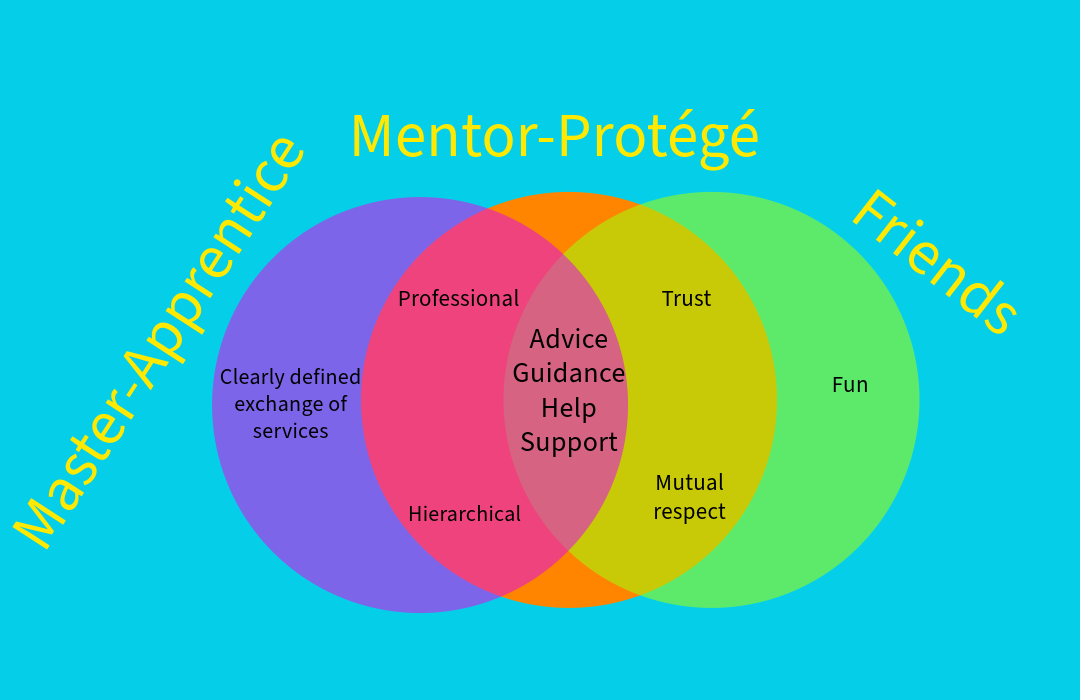
In a master-apprentice relationship, the master provides advice, guidance, help, and support in a professional setting. The master is above the apprentice in the professional hierarchy. There is also a clearly defined exchange of services whereby the master provides advice, guidance, help, and support in exchange for the apprentice's labor, today or in the future.

In a mentor-protégé relationship, there is no official exchange of services. The mentor provides advice, guidance, help, and support. Sometimes the mentor expects something in return, and sometimes they don't. I've seen in academic settings a research mentor pressure the protégé to follow in their footsteps and publicly glorify the mentor's accomplishments. In the worst case scenarios, a mentor can abuse their status by sexually harassing their protégé, demanding work from the protégé without compensation, or plagiarizing the protégé's work. The best mentors provide advice, guidance, help, and support as an act of selfless service. Still, others break their protégé’s trust and use selflessness as a cover for exploitation. Mentors can get away with bad behavior because of the ambiguity around what is expected from the protégé in the relationship and the hierarchical nature of the mentor-protégé relationship.
The master-apprentice relationship is a hierarchical relationship where the master is above the apprentice, and the master tells the apprentice what to do. In a professional context, this hierarchy makes sense. The master knows more than the apprentice about the work, and the apprentice should, therefore, do as the master says. A friendship, however, is built on mutual respect, the opposite of a hierarchy. A friendship where one friend is allowed to tell the other friend what to do without reciprocity isn't a friendship at all. And yet, the mentor-protégé relationship paradoxically sits between the master-apprentice relationship and the friendship.
Outside of my workplace, I'm not interested in taking on an apprentice-like protégé. Suppose I like someone enough to want to be their mentor. If that's the case, I would already respect that person enough not to put myself above them in a made-up hierarchy. Furthermore, I'd rather have a friend than a protégé because friendship is fun. I don't want to take on obligations that aren't fun.
But if I wouldn't mentor someone I'm not willing to be friends with, is that problematic? Aren't friendships biased in gender and race? Yes, that can be true, which is why I maintain as a value that I could be friends with anyone, regardless of their age, race, gender, or neurotype. Because why not? "Why can't we be friends?
I will concede that I can't be friends with someone who wouldn't be friends with me. That does eliminate anyone who doesn't like me because of my race, gender, or neurotype. But I don't think those people would ask me to be their mentor anyway.
So, know that if you ask me to be your mentor, and we aren't coworkers, my answer will be: "Can we just be friends instead?" I can be the kind of friend who offers advice, guidance, help, and support because that's what friends do.
Love it! Forty years ago, I wrote an essay on management relationships. I tried every management structure known to mankind except Intel's two-in-a-box. I suggested three kinds of manager-subordinate relationships: malevolent, do it, or you are fired; benevolent, praises and raises for showing up; and consenting adults. The worst is benevolent because both parties think that the boss is good and the subordinate owes it to the boss (or child to parents), The best and most profitable in the long run is consenting adults, which means that the manager and employee have other good options and know what they are yet voluntarily choose this working relationship. Also, both have fun, an element of playfulness in working together as equal people. I also suggested that Fun was the F word of management, something I was kidded about.
Love this and I agree you 100%!
I recently was asked to zoom with a professional connection to "catch up". Instead of a back-and-forth conversation, it was 80% of this person complaining about their work and asking for advice, and 20% of me talking, trying to give them advice.
At the end of the call, they asked "Can we do this once a week as a professional check-in and support chat?" I had to say "Sorry, I don't think I can find a time every week to do this."
And now I feel like I'd never say yes to their "catch-up" invite anymore. It's so hard, but boundaries are so important!